

Royalty-Free Tango Recordings for Professional Use
The recordings are produced for use in structured movement practice and professional training contexts.
With the purchase, you receive a non-exclusive usage license from Movidamente S.A.
With the purchase, you receive a non-exclusive usage license from Movidamente S.A.
License Scope
The license permits the use of the recordings in:
- training sessions and courses
- therapeutic and educational settings
- seminars, classes, and public presentations
- online use (e.g. websites, YouTube, social media)
Redistribution, resale, or transfer of the recordings to third parties is not permitted.
A written license confirmation can be requested by submitting your invoice via the contact form.
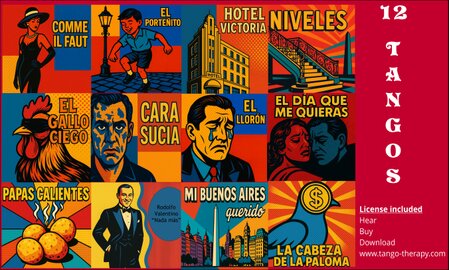
✅Gallo Ciego – Agustín Bardi †1941 (3:36 min)
✅Rodolfo Valentino (also known asNada más) – Luis Rubistein †1954 (3:09 min)
✅Hotel Victoria – Feliciano Latasa †1906 (2:58 min)
✅Papas Calientes – Eduardo Arolas †1924 (2:43 min)
✅Mi Buenos Aires querido – Carlos Gardel †1935 (2:12 min)
✅El día que me quieras – Carlos Gardel †1935 (3:12 min)
✅Cara Sucia – Casimiro Alcorta †1913 (2:52 min)
✅Comme il faut – Eduardo Arolas †1924 (2:26 min)
✅Niveles – Improvisation “Niveles” – Original composition (Neuro preliminary exercise 2) (3:57 min)
✅Rodolfo Valentino (also known asNada más) – Luis Rubistein †1954 (3:09 min)
✅Hotel Victoria – Feliciano Latasa †1906 (2:58 min)
✅Papas Calientes – Eduardo Arolas †1924 (2:43 min)
✅Mi Buenos Aires querido – Carlos Gardel †1935 (2:12 min)
✅El día que me quieras – Carlos Gardel †1935 (3:12 min)
✅Cara Sucia – Casimiro Alcorta †1913 (2:52 min)
✅Comme il faut – Eduardo Arolas †1924 (2:26 min)
✅Niveles – Improvisation “Niveles” – Original composition (Neuro preliminary exercise 2) (3:57 min)
Musical Structure and Application
The recordings are selected and arranged to provide clear rhythmic structure and continuity for movement-based practice.
They are intended to support orientation, timing, and consistency in professional movement contexts.
They are intended to support orientation, timing, and consistency in professional movement contexts.
Tango as Cultural Heritage
Tango was recognized by UNESCO as Intangible Cultural Heritage.
The recordings were produced by the Movidamente orchestra in Buenos Aires.
All works are based on compositions by composers who passed away more than 70 years ago, ensuring public domain status of the original compositions.
This allows lawful production and licensing of the recordings for professional use.